

The Basic Soldering Guide Photo Gallery
Soldering is a delicate manual skill which only comes with practice. Remember that your ability to solder effectively will determine directly how well the prototype or product functions during its lifespan. Poor soldering can be an expensive business - causing product failure and downtime, engineer's maintenance time and customer dissatisfaction. At hobbyist level, bad soldering technique can be a cause of major disappointment which damages your confidence. It needn't be like that: soldering is really easy to learn, and like learning to ride a bike, once mastered is never forgotten!
These photos illustrate the basic steps in making a perfect solder joint on a p.c.b. If you're a beginner, our advice is that it's best to practice your soldering technique using some clean, new parts with perhaps some new stripboard (protoboard). Be sure to avoid using old, dirty parts; these can be difficult if not impossible to solder.
The new Basic Desoldering Guide is a photo sequence illustrating the use of solder pumps and braid, and a few genuine examples (honest) of bad soldering.

Boards must be clean to begin with, especially if they're not previously "tinned" with solder. Clean the copper tracks using e.g. an abrasive rubber block.
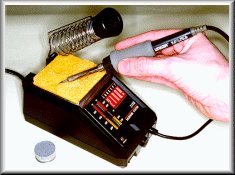
Clean the iron "bit" (tip) using a damp sponge. Iron featured is an Ungar Concept 2100 Soldering Station.
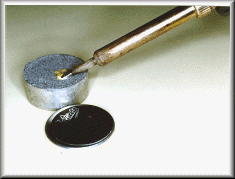
A useful product is Multicore's Tip Tinner Cleaner (TTC) - a 15 gramme tin of special paste which cleans and "tins" the iron, in one go.
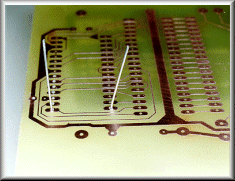
Insert components and splay the leads so that the part is held in place.
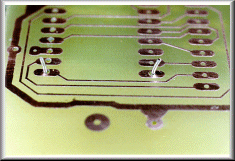
It's usually best to snip the wires to length prior to soldering. This helps prevent transmitting mechanical shocks to the copper foil.
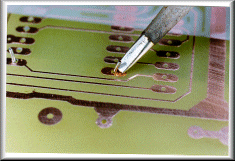
Apply a clean iron tip to the copper and the lead, in order to heat both items at the same time.
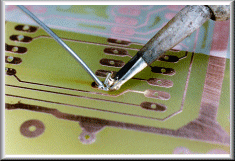
Continue heating and apply a few millimetres of solder. Remove the iron and allow the solder joint to cool naturally.
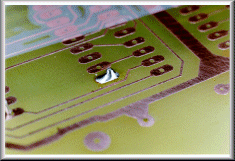
It only takes a second or two, to make the perfect joint, which should be nice and shiny. Check the Guide for troubleshooting help.
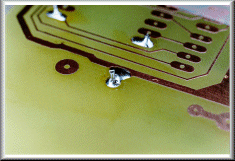
An example of a "dry" joint - the solder failed to flow, and instead beaded to form globules around the wire.
On to the Basic De-soldering Photo Gallery (and Black Museum of Bad Soldering...)
Small-print: these photos are Copyright © Alan Winstanley 1997. You may download them for personal use, training or education only. High resolution photos are also available on CD from the author, for a modest royalty. If you wish to use them for any commercial reasons, e.g. to enhance any commercial product, enframe in any external commercial web site or apply for any other commercial use, you must seek my prior approval first. This email address is being protected from spambots. You need JavaScript enabled to view it. Alan Winstanley's Home Page.
